Dana Schröder · 18 November 2026
Tracing Data Flows in AI-Enhanced Financial Ecosystems for Niche Platform Growth
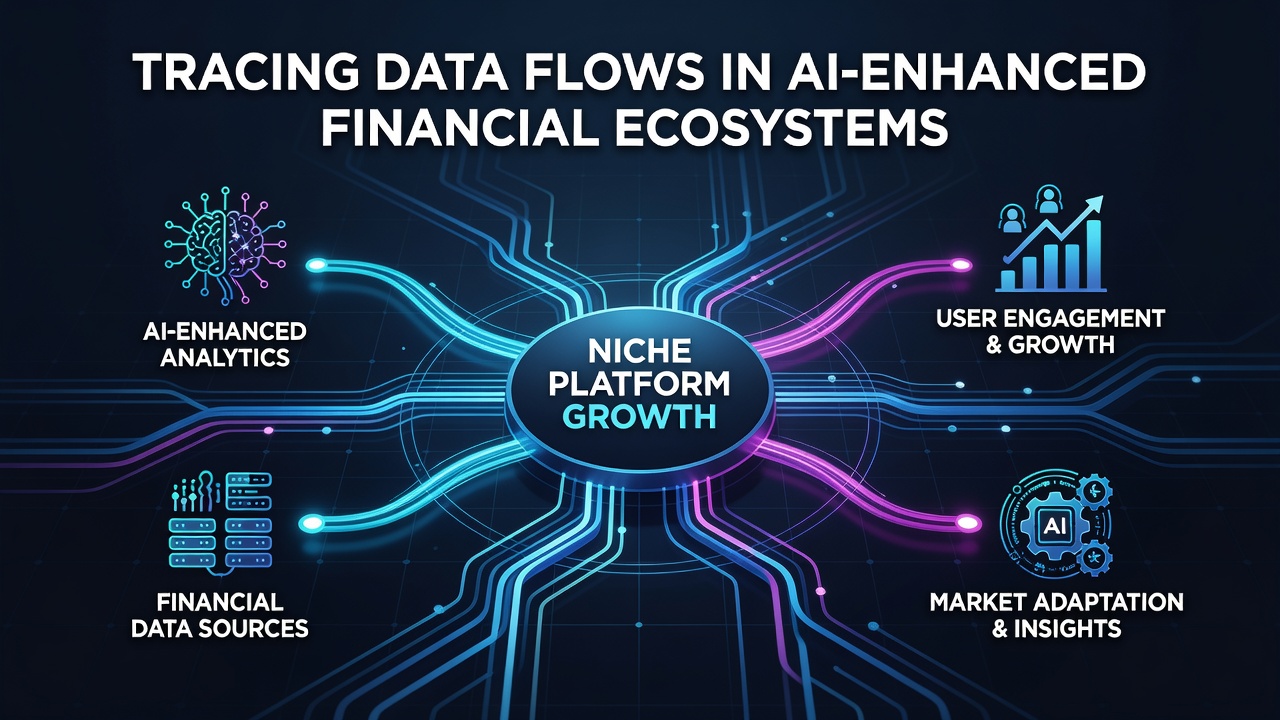
Financial ecosystems now rely on layered data movements that connect transaction records, user behaviors, market signals, and predictive models, and tracing those movements has become essential for niche platforms seeking sustainable expansion. Observers note that platforms operating in specialized segments such as regional lending networks or sector-specific investment tools generate high volumes of structured and unstructured information each day, yet the paths this information takes often remain opaque without systematic mapping techniques.
Core Components of Data Movement in AI-Driven Finance
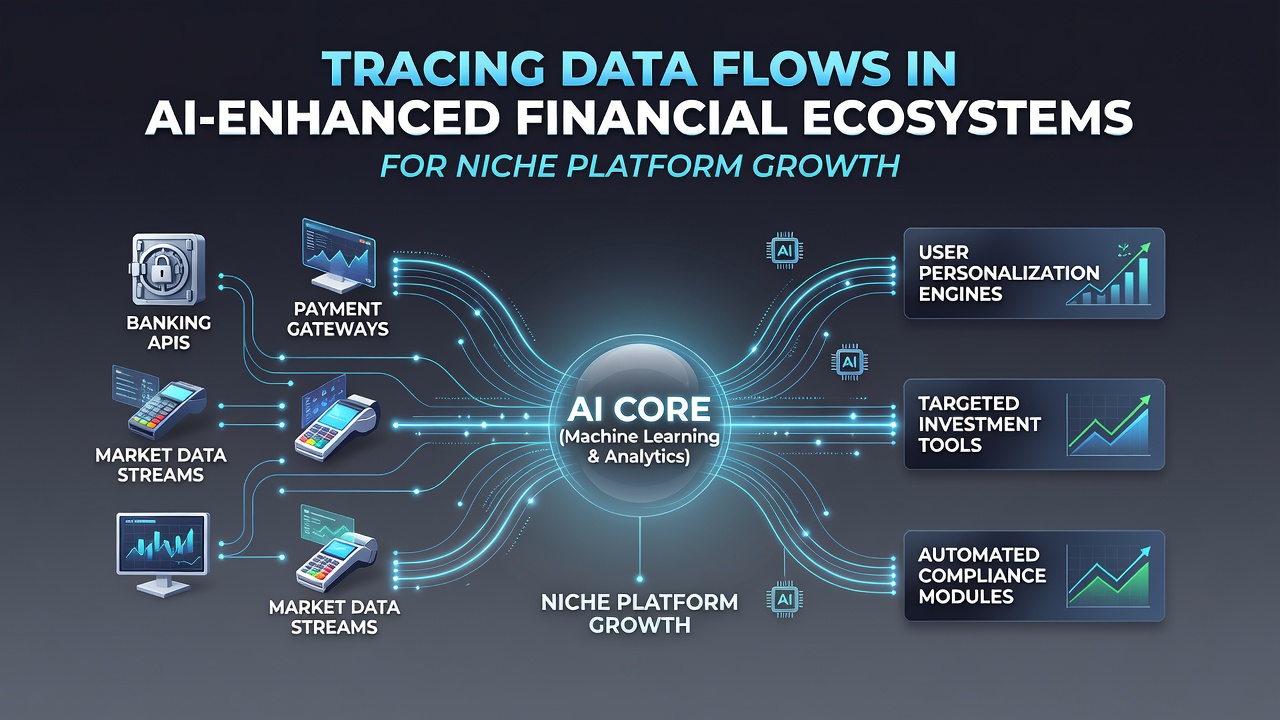
Researchers describe data flows as sequences that begin with raw inputs from customer interactions, regulatory filings, and external market feeds, then proceed through preprocessing stages before entering machine learning pipelines that generate forecasts, risk scores, and automated recommendations. Those pipelines frequently incorporate graph databases and real-time streaming engines, which allow continuous updates rather than batch processing, and the resulting outputs feed back into both internal decision systems and external reporting dashboards. According to reports from the U.S. Securities and Exchange Commission, platforms that maintain detailed lineage records demonstrate faster compliance audits because regulators can reconstruct how individual data points influenced final outputs.
Specialized platforms gain an advantage when they isolate data paths that directly affect user retention and capital allocation, since these segments often operate with narrower margins than broad-market institutions. Data lineage tools record each transformation step, including feature engineering choices and model retraining events, which helps teams identify bottlenecks that slow response times during market volatility. One documented case involved a mid-sized platform serving agricultural finance clients that reduced latency by 34 percent after mapping the journey of satellite imagery data through its yield-prediction models.
Techniques for Mapping and Monitoring Flows
Tracing methods combine metadata tagging, cryptographic hashing of records, and distributed ledger entries that timestamp every access or modification event. Teams deploy these approaches across cloud environments where microservices handle ingestion, transformation, and inference tasks in parallel, and the resulting audit trails integrate with visualization layers that display flow diagrams updated at sub-second intervals. Evidence from academic studies published in the Journal of Financial Data Science indicates that platforms adopting such combined techniques achieve higher accuracy in detecting anomalies, particularly when models process cross-border payment streams subject to varying data-protection rules.
November 2026 marks the scheduled implementation of updated data-governance frameworks in several jurisdictions, including enhanced reporting requirements for algorithmic decision systems used by financial entities. Platforms preparing for these changes have begun embedding automated compliance checks directly into their data pipelines, which allows real-time flagging of records that might trigger additional scrutiny under the forthcoming standards. Observers report that early adopters gain operational continuity because their tracing infrastructure already captures the variables regulators will request during routine examinations.
Growth Implications for Niche Platforms
Niche operators frequently compete by offering customized risk models that depend on proprietary datasets, yet scaling these models requires verifiable proof that data quality remains consistent across expanding user bases. Tracing capabilities supply that proof by quantifying how input variations propagate through successive model layers and ultimately affect output distributions. Industry analyses from the European Securities and Markets Authority show that platforms providing transparent lineage documentation attract institutional partners more readily, because counterparties can assess model robustness without extensive custom due diligence.
Integration with external data marketplaces introduces additional complexity, since third-party feeds arrive with their own schemas and update frequencies. Successful implementations establish canonical identifiers that persist across merges and joins, enabling downstream AI components to reference the same underlying facts regardless of source. Researchers at the Bank of Canada have documented similar patterns in open-banking environments, where standardized tracing reduced reconciliation errors between participant institutions by measurable margins.
Conclusion
Effective tracing of data flows supplies niche financial platforms with the visibility needed to refine AI models, satisfy evolving regulatory expectations, and demonstrate reliability to partners. As frameworks advance in November 2026 and beyond, organizations that maintain comprehensive lineage records position themselves to adapt quickly while continuing to serve specialized market segments with precision.