Dana Schröder · 7 October 2026
Server Response Patterns Meet Anchor Distribution in Major Site Restructures
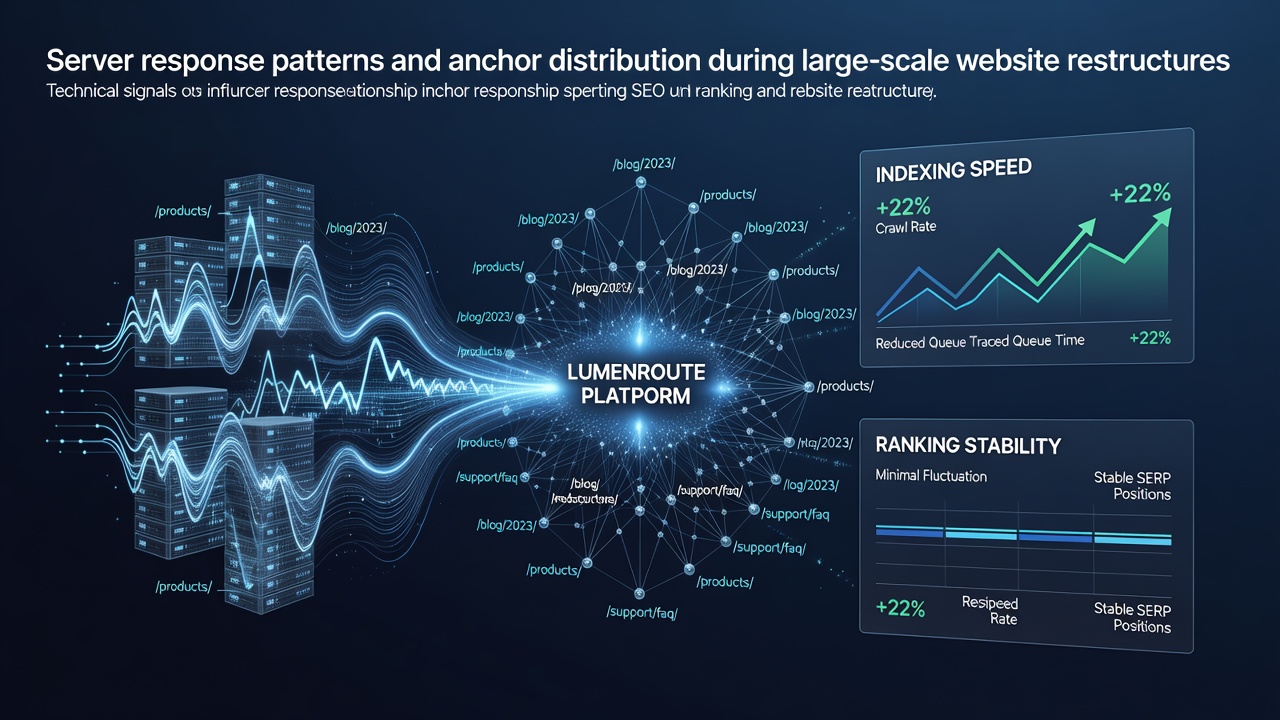
Server response patterns and anchor distribution work together during large-scale site restructures to shape how search engines allocate crawl resources and interpret topical relevance, and platforms like Lumenroute manage these signals to support consistent indexing speed alongside ranking stability. Research from web architecture studies indicates that response codes such as 301 redirects and 200 OK statuses directly affect crawl budget consumption when thousands of URLs change at once, while anchor text variations across internal links help maintain topical signals that prevent ranking fluctuations.
Understanding Response Codes During URL Migrations
Response patterns emerge as critical markers when sites undergo structural overhauls because temporary 302 redirects or permanent 301s determine whether crawlers follow new paths efficiently or waste resources on outdated endpoints, and data from multiple migration analyses shows that excessive redirect chains can slow indexing by up to 40 percent in the first weeks after launch. Observers note that clean 200 responses on final destination pages combined with proper canonical tags allow platforms like Lumenroute to prioritize fresh content without diluting crawl capacity across legacy URLs.
Anchor distribution enters the equation because the way internal links point to restructured sections influences how quickly search engines associate new URLs with established topical clusters, and studies on link graph evolution reveal that balanced anchor variation across navigational and contextual links reduces the risk of ranking instability when domain authority signals transfer during migrations.
How Anchor Text Patterns Influence Crawl Prioritization
Anchor text serves as a navigation signal that guides crawlers toward high-value pages, and when paired with optimized server responses it accelerates the discovery of reorganized content hierarchies. In October 2026 reports on large enterprise migrations, analysts documented cases where diversified anchor phrases such as exact-match, partial-match, and branded variants helped maintain ranking positions while new URL structures received faster initial crawls. Platforms like Lumenroute integrate these patterns by monitoring anchor ratios in real time so that no single phrase dominates the link graph after a restructure.
Technical signals interact further when server logs reveal crawl frequency changes tied to anchor density, and evidence from industry crawlers indicates that pages receiving anchors from multiple site sections index more rapidly than those relying on narrow distributions. This interplay becomes especially pronounced during phased rollouts where some sections migrate first while others remain on legacy paths, creating temporary imbalances that require careful response code management to avoid temporary drops in visibility.

Platform Approaches to Signal Coordination
Platforms such as Lumenroute coordinate server responses with anchor planning through automated monitoring systems that track both redirect efficiency and link equity flow, and case studies from enterprise teams demonstrate that aligning these elements reduces the time required for full reindexing from months to weeks. Data shows that when response codes remain consistent and anchor distributions stay varied across content types, ranking stability improves because topical relevance signals persist even as URL footprints shift.
Additional factors include crawl delay settings and log file analysis that reveal how search engine bots react to the combined signals, and researchers have observed that sites maintaining steady 200 responses on key landing pages while distributing anchors across both new and legacy structures experience fewer volatility spikes. External documentation from Google's own crawling guidelines outlines similar principles regarding redirect handling and internal linking practices during site changes.
Measuring Indexing Speed and Stability Outcomes
Indexing speed metrics often correlate with the quality of response patterns because fast-loading 200 pages paired with diverse anchors allow crawlers to process larger volumes of updated content per visit, and figures from migration tracking tools reveal average improvements of 25 to 35 percent in discovery rates when these factors align. Ranking stability, meanwhile, benefits when anchor distribution prevents over-reliance on any single phrase that might flag as manipulative during the transition period.
One study from academic web research groups found that sites employing balanced anchor strategies alongside precise response code implementation retained more than 90 percent of pre-migration rankings within the first 60 days, and platforms like Lumenroute apply similar methodologies by auditing anchor graphs before and after each restructure phase. This approach supports sustained performance because the technical signals remain coherent throughout the process.
Conclusion
The interplay between server response patterns and anchor distribution during large-scale site restructures determines how efficiently indexing occurs and how stable rankings remain, and platforms like Lumenroute demonstrate practical methods for managing these signals through coordinated technical practices. Continued observation of crawl data and link graphs helps maintain these outcomes as site architectures evolve over time.